
The pipes hidden above the ceiling are something a homeowner never sees in a lifetime, yet they decide a decade of comfort. The equipment you can see lets you compare brands and specifications; the installation you cannot see is what earns your trust. That is the old problem of the central-air-conditioning industry, and in water-system products, where water is the medium, the problem is magnified.
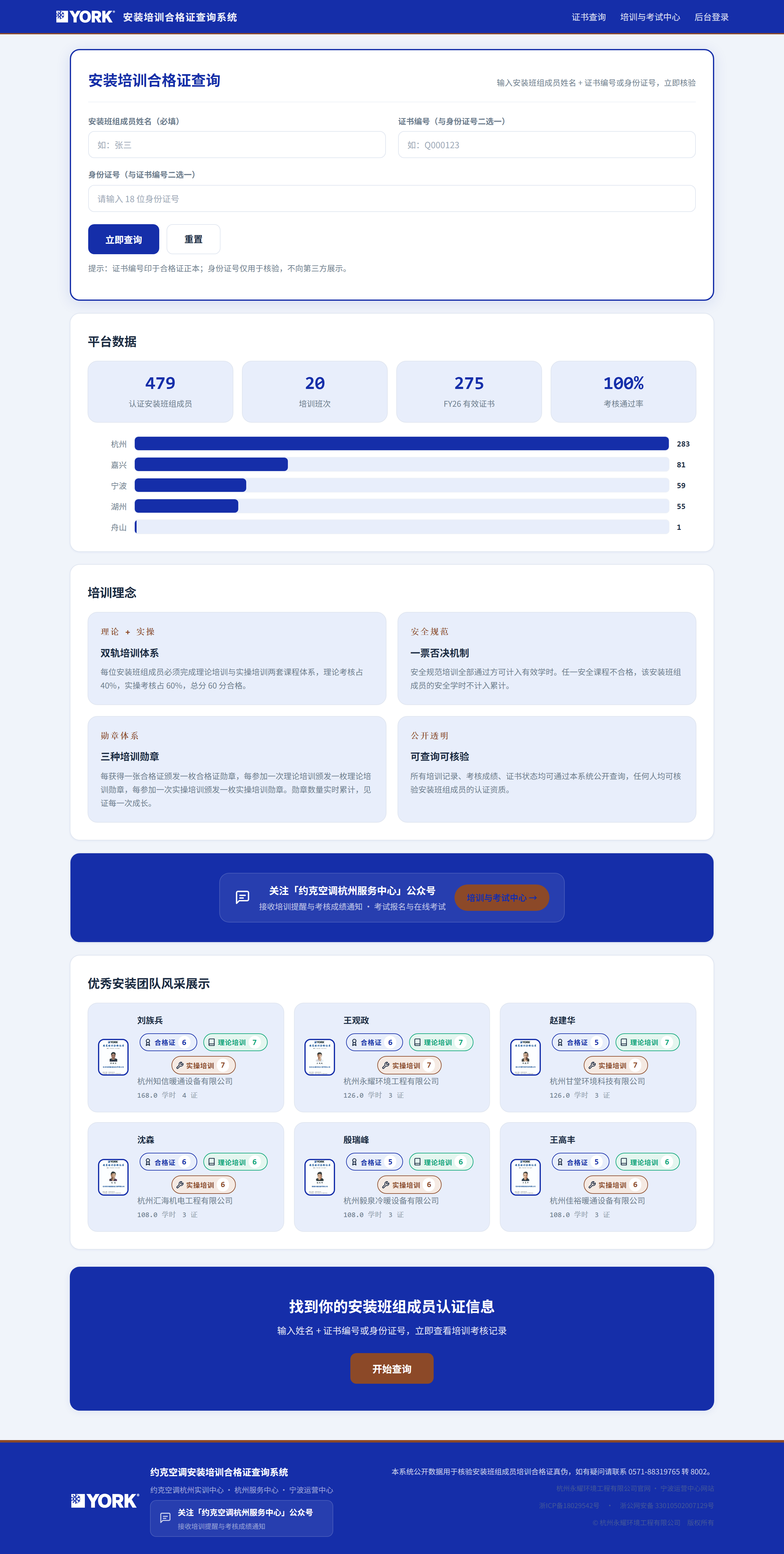
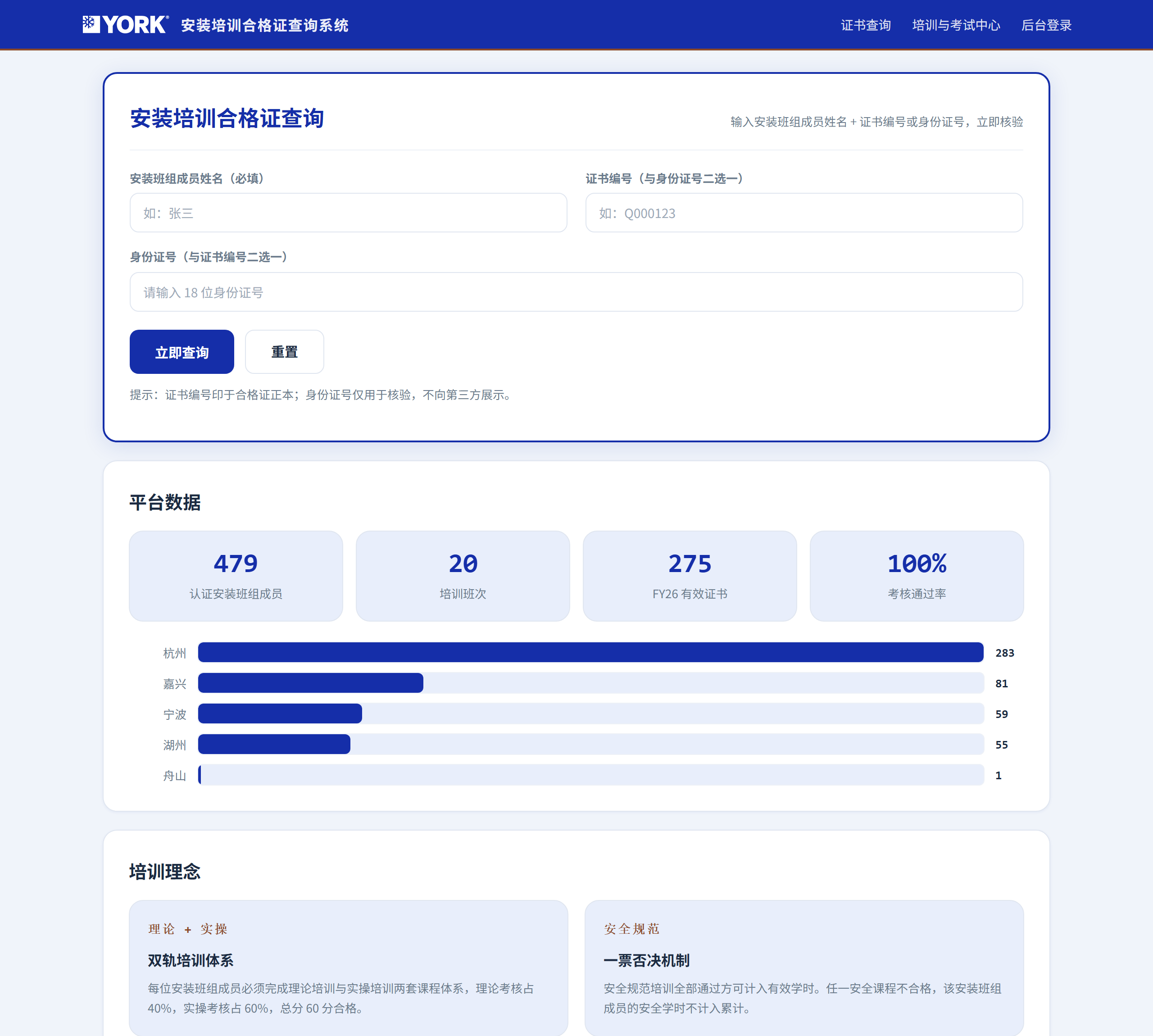
Recently, the YORK installer certification and training-record system covering Hangzhou, Jiaxing, Huzhou, Ningbo and Zhoushan went live at peixun.hzvav.com. The numbers on its home page answer that old problem more directly than ever. Nearly 500 certified installers are on the register, more than 20 training batches have been run, almost 300 certificates are valid this fiscal year, and the assessment pass rate is 100 percent.
A certified workforce is built batch by batch
The scale of nearly 500 people was not assembled in a single sign-up drive.
Hangzhou Yongyao Environmental Engineering Co., Ltd. has operated YORK water-system central air conditioning in northern Zhejiang for years and has trained more than 600 front-line installers in total. The training runs one cohort after another, from the theory classroom to the hands-on site, from the Hangzhou headquarters to the dealer outlets across the region. The team includes Yongyao's own fitters as well as members from local dealers and engineering companies. When an order comes in and the site opens, it is these people who install water-system central air conditioning for thousands of homes.
In the past, these training records were scattered across sign-in sheets, score reports and paper certificates from each batch. To verify one person's certificate meant digging through stacks of material and asking several handlers. Now every member's profile is unified in the system, with training hours, scores, badges and certificate status all mapped one to one, searchable by anyone at any time. For the first time, years of accumulated capability are presented as open data.
For water systems, quality is mostly made on site
The operating logic of a water-system central air conditioner sets the weight of installation.
The outdoor unit makes chilled and hot water in the plant room and sends heating and cooling to the terminal in every room through piping. A poor weld leaks and soaks the ceiling. Incomplete insulation condenses on the pipe and stains the ceiling with a ring of water. Air left in the lines cuts heat-exchange efficiency and pushes the electricity bill up. Unbalanced terminal hydraulics leave the farthest room slow to cool. Equipment is fully inspected before it leaves the factory; whether the system finally works well depends, more than half, on the hands on the site.
The industry says three parts product, seven parts installation. For water systems, that seven parts should be pushed even higher. That is exactly why certified, on-site work is not a formality but the baseline on which this product line's reputation stands.
From findable to manageable
The new system manages installation across the whole process.
On the training side, theory and practice run on two tracks. Every installer must complete two course sets, with theory at 40 percent and practice at 60 percent of the assessment, and a pass mark of 60. Safety rules carry a veto: failing any safety course means the safety hours are not counted. Beyond assessment there are badge incentives. Earn one certificate, get one certificate badge; attend one theory session and one practice session, get the corresponding badge each. Badge counts accumulate in real time and follow the person, recording growth.
The verification side is open to the whole society. Enter a name plus a certificate number or ID number, and a match returns the full profile. Paper certificates carry a QR code; the verifier scans it with a phone and opens the certificate detail page directly, with course details, exam scores and certificate validity all inside. For owner acceptance, property spot-checks and regulatory verification, one scan confirms certification.
Installers follow the YORK Hangzhou service-center official account, where training reminders, score notices, exam registration and online testing all happen inside WeChat.

Five cities, visible growth
By region, certified installers are on duty in all five cities: Hangzhou, Jiaxing, Ningbo, Huzhou and Zhoushan. In the system's showcase of outstanding installation teams, members come from different HVAC companies and engineering firms; some hold multiple certificates with hundreds of training hours, their theory and practice badges lined up one by one. Growth is recorded and progress is visible, which is itself a positive pull for the installers.

For Yongyao, this system is a concentrated presentation of years of regional operation. For the northern-Zhejiang market, it moves the lifeline of installation quality from experience-based management to digital management. Training is recorded, assessment has scores, certificates can be verified. The invisible seven tenths now have evidence to stand on.